Belize moves to a different rhythm, from dazzling coral reefs to majestic Maya ruins, it offers a rare combination of natural beauty, layered history, and easygoing hospitality. English-speaking, small in scale, and shaped by Caribbean, Maya, and colonial legacies, it feels curiously old-fashioned — in the best of ways. Time stretches here. Conversations run long. And despite the growing reach of tourism, there’s still space to exhale
It’s a country of contrasts: reef and rainforest, Creole and Maya, laid-back islands and rugged back roads. Visitors’ cross paths with Mennonite farmers, Garifuna musicians, barefoot fishermen, and Rastafarian street poets — often in the same day. And beneath the surface, both literally and metaphorically, lie fragile ecosystems and untold stories.
This is a place where the land holds memory, of hurricanes and empire, of ancient pyramids and underworld rivers, and where each journey reveals a little more of Belize’s quiet, complicated charm.
Table of Contents
San Ignacio and the Western Highlands
Crossing into Belize from Guatemala feels like entering a slower, softer world. The road dips gently past fruit stands and Mennonite farms, before arriving in San Ignacio, a friendly, sun-dappled town that serves as the country’s inland hub. Midas Lodge, tucked away in the forest just beyond the centre, offered a peaceful base, complete with colourful birds and the distant hum of cicadas.
The town itself is small but lively, with a central market, welcoming locals, and surprisingly good food options, though on Sundays many places are closed as religion and traditions still play an important role in life in Belize. It’s also a perfect springboard for exploring Belize’s interior: caves, rivers, ruins, all within reach.
Adventure and Water Tourism near San Ignacio
Beyond ruins and markets, the San Ignacio region is an adventure hub. Caving, tubing, horse-riding, and river kayaking are all on offer within easy reach of town. The Macal River provides a natural corridor for day trips, while nearby caves like Actun Tunichil Muknal (ATM) offer immersive experiences blending archaeology, physical challenge, and eerie Maya underworld mythology. More relaxed options include guided river tubing or swimming at shaded spots along the riverbank.
Caracol and the Great Maya Rivalries
Deep in the forest and reached via rough tracks, Caracol feels like a place only half reclaimed from the jungle. Unlike its better-known rivals Tikal (Guatemala) and Calakmul (Mexico), Caracol receives only a trickle of visitors, which makes standing atop its towering pyramid Caana, or “Sky Palace”, all the more surreal. At its peak, Caracol was the dominant power in the region, defeating both Tikal and Naranjo in classic Maya warfare. Today, spider monkeys and toucans accompany your visit, and the site’s isolation only adds to its grandeur.
There were many recorded interactions between the Maya cities, one notable incident is the story which is known from detailed stucco inscriptions in Caracol of Lady B’atz’ Ek’, a noblewoman of Calakmul who married into Caracol’s royal dynasty. Around AD 599, she was sent, likely as part of a political alliance, to marry Lord K’an II, Caracol’s ruler at the time. This union helped cement ties between Caracol and Calakmul, two powerful Classic Maya cities, especially during a period when Caracol had previously defeated Tikal and was shifting alliances in the high-stakes regional power game. She is thought to be buried at the top of the pyramid, Caana.
Despite its importance, Caracol is not (yet) a UNESCO World Heritage Site, likely due to Belize’s lack of resources say when compared to neighbouring Mexico, its remoteness, partial excavation, and Belize’s prioritisation of natural over archaeological nominations. But among Maya archaeologists, its significance is undisputed.


Caracol Archaelogical Site and Spider Monkeys, Belize
Tropical Pine Forest on route to Caracol
The journey to Caracol is long and rugged, the road has been recently improved, however in parts construction is still taking place, but unexpectedly beautiful. After passing the pools and lowland jungle, the route climbs into an unusual belt of tropical pine forest, a distinct biome more commonly associated with the Caribbean foothills of Honduras or certain upland parts of Mexico. The scent of resin and coolness of the air are a striking contrast to the lush humidity below, creating a moment of unexpected stillness on the way to one of the great Maya capitals.
Along the journey there and back, the Rio on Pools offers a natural spa stop, a cascade of granite basins perfect for cooling off. Not far beyond lies a cave system, like a tunnel, near Augustine, mysterious and water-fed, giving a glimpse into the underworld of ancient Maya beliefs.
Between Belmopan and San Ignacio: Fertile Heartland
This stretch of inland Belize is strikingly green, a fertile, low-lying zone dotted with citrus groves, smallholdings, and Mennonite farms. It feels productive and peaceful, and hints at the country’s agricultural potential. The road west from Belmopan to San Ignacio is one of the few in the country that feels gently prosperous, with fruit stalls along the way and rich alluvial soil sustaining farms on either side.
Belize City: Between Storm and Sea
By contrast, Belize City feels less forgiving. Though no longer the capital, it still carries the weight of history, from crumbling colonial buildings to vivid memories of natural disasters. Crime is a real concern here, and most travellers move through quickly, heading to or from the boat terminal. Yet in conversation, locals remain warm and proud. The sea is ever-present, and so too are stories of resilience, particularly in the wake of Hurricane Hattie, which struck with devastating force in 1961.
Hurricane Hattie (1961)
In October 1961, Hurricane Hattie struck Belize City with catastrophic force. Winds of over 160 mph flattened much of the capital, leading to more than 300 deaths and prompting the relocation of the capital inland to Belmopan. For many Belizeans, it remains a defining moment, a collective trauma passed down through generations. Today it is a frequent topic of conversation amongst Belizians even though it happened nearly 65 years ago. In our family, it was the subject of countless stories from my aunt, who was in Belize at the time. Her tales of flooding, and destruction shaped my earliest understanding of Belize long before I ever set foot there.
Caye Caulker: Go Slow, Stay Long
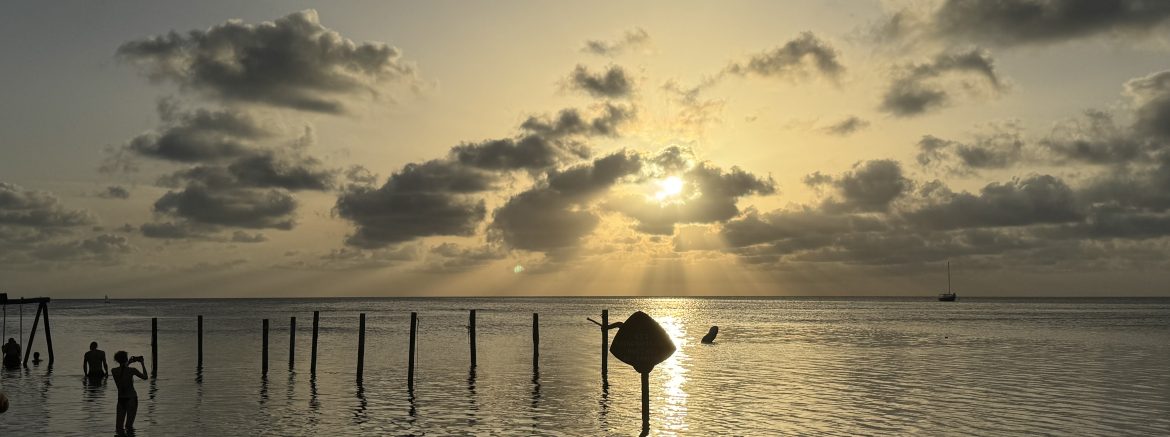
The ferry to Caye Caulker is a rite of passage, easing out from the mainland into a turquoise world. The island’s motto, “Go Slow”, still rings true, even if tourism has brought with it golf carts, beach bars, and reggae beats. Yet there’s something enduringly genuine about Caye Caulker. Hammocks swing beneath palms, fishermen haul in fresh catch, and the sunsets glow orange over the water. It’s the kind of place where time slips past unnoticed, a perfect counterpoint to the mainland’s weightier stories.
Caye Caulker still moves to the rhythm of its motto — “Go Slow” — though tourism has certainly arrived. Yet in July’s low season, the island felt like a place caught between its laid-back past and an uncertain future: too many bars, restaurants and tour operators for the number of visitors. It echoed that same tension felt in the Guatemalan Highlands: a tourism economy built for a crowd that hasn’t quite come. Despite the infrastructure oversupply, Caye Caulker retains its charm, part Caribbean village, part reef-side retreat.
Beneath the Surface: Belize’s Marine World
One of Belize’s greatest treasures lies just offshore, the Belize Barrier Reef, a UNESCO World Heritage Site and the second-largest reef system in the world. From Caye Caulker, we joined a full-day snorkelling trip with Ragga Sailing Ventures, taking in four separate swims across different reef zones. The sea was warm and crystal clear, revealing a marine world of startling richness: schools of tropical fish, nurse sharks, sea turtles, and even manatees, asleep on the ocean floor, then rising peacefully for air, unaware of the surrounding humans.
But even in paradise, signs of stress are visible. Some coral showed early bleaching, and the underwater environment felt fragile, vibrant, yes, but in need of protection. Our guides followed best practices, avoiding contact with wildlife and stressing reef-safe behaviour. Not all operators do. We saw others throwing bait into the sea to attract nurse sharks, disrupting natural behaviours for entertainment. On land, large fish like the protected tarpon, were being fed at the docks to draw them into the shallows, along with rays, practices that blur the line between education and exploitation.
Belize’s marine conservation efforts are ambitious but uneven. On paper, there’s strong intent: protected zones, marine reserves, and responsible tourism initiatives. But enforcement is patchy, and economic pressure, especially in low season, make unsustainable practices tempting for some businesses. Still, there is cause for hope. Many locals are proud of the reef and its creatures. Awareness is growing. And for travellers, choosing ethical operators and following reef etiquette, is an easy and impactful step.
Visitors can help by choosing licensed, reef-safe tour operators, avoiding direct contact with wildlife, using reef-safe sunscreen, and skipping tours that rely on baiting or unnatural feeding behaviours. Sometimes, the most respectful encounters are the most memorable.


Caye Caulker and the Belize Barrier Reef
Belize’s Coastal Wildlife
- Tarpon (Megalops atlanticus) – Large, silver fish often seen near docks in Caye Caulker; protected in Belize and prized by sport fishers. Known for leaping when fed, a controversial tourist practice.
- Great Barracuda (Sphyraena barracuda) – Streamlined predators with silver bodies and a toothy underbite. Often seen in small groups; common but still visually impressive.
- Southern Stingray (Hypanus americanus) – Wide, flat rays with dark backs and pale bellies, commonly seen in shallow sandy areas, especially where they’re fed to lure them near shore.
- Spotted Eagle Ray (Aetobatus narinari) – Elegant rays with white spots and a long whip-like tail. More often seen gliding in open water or deeper reef zones. conservation efforts.
- Nurse Shark (Ginglymostoma cirratum) – Bottom-dwelling and docile, often drawn to boats by baiting. Generally harmless to humans but sensitive to overexposure.
- West Indian Manatee (Trichechus manatus) – Slow-moving, gentle sea mammals often found in calm coastal waters. Listed as Vulnerable, they are strictly protected in Belize.
- Green Turtle (Chelonia mydas) and Loggerhead Turtle (Caretta caretta) – Regular visitors to the reef and seagrass beds. Both are endangered and part of international
- Caribbean Reef Octopus (Octopus briareus) – A shy, intelligent mollusc with iridescent skin. Not rare, but extremely hard to spot due to its camouflage. A real treat for observant snorkellers.
Kriol Culture and Caribbean Crosscurrents
Belizean Kriol (Creole) is more than a language — it’s a lived culture. Rooted in the Afro-Caribbean experience of former slaves and coastal settlers, Kriol evolved from English vocabulary shaped by West African grammar and rhythm. Today, it’s spoken by much of the population, whether as a first or second language, and carries with it a distinctive tone of warmth, humour, and storytelling.
In the streets and buses of Belize City, Creole identity blends with a strong Jamaican influence, heard in reggae and dancehall, seen in Rastafarian colours, and tasted in drinks like the locally made “Rude Boy”, an unapologetically named canned cocktail with a kick. Music is omnipresent, from bassy beats pumping from corner stores to live drumming on public holidays. While Belize shares this Caribbean spirit with countries like Guyana, here it sits alongside ancient Maya roots, creating a cultural mix that’s both unexpected and unforgettable. But while Guyana felt more orderly, secure, and steeped in West Indian staples like cricket, Belize had something Guyana didn’t: the layered grandeur of Maya history, still visible in the forested ruins of Caracol and beyond. Culturally, Guyana felt closer to the Caribbean islands; Belize straddles that line between Caribbean rhythm and Central American roots.


Sip ‘N Dip Bar, Street BBQ Lobster, Tarpon, Frigate Bird, Southern Stingray
Food, Heat, and a Cold Belikin
Belizean food is hearty, comforting, and full of character. The national staple is rice and beans with stewchicken, typically served with a side of plantain and a generous spoon of Belizean hot sauce, tangy, fiery, and made from habaneros. You’ll find it on every table, from roadside eateries to seaside grills.
On Caye Caulker, seafood is the star. In lobster season, which starts in July, whole tails are grilled at beachfront BBQs, slathered with garlic butter and served with coconut rice or potato salad, best eaten on the beachfront under palm trees, with gentle waves lapping up the beach and frigate birds and pelicans flying overhead.
To drink, nothing beats a cold Belikin, the local beer comes in two popular varieties: a light lager, crisp and easy-going, and a rich creamy stout, which is curiously beloved — echoing beer traditions in places like English-speaking West Africa. It’s an unusual taste profile for Central America, but one that feels right at home here.
Getting Around
Belize’s transport feels as unhurried as the country itself. Chicken buses, often retired US school buses, now repainted and repurposed, ply the inland routes with a mix of locals and a handful of backpackers. The journey from San Ignacio to Belize City is slow but straightforward, and the water taxi to Caye Caulker runs several times a day. Roads in the interior can be rough, so 4WDs or guided tours may be the best option for remote sites.


Clock Tower, Belize City; Chicken Bus; Caye Caulker
Historical Layers
Belize’s story is distinct from its neighbours. Formerly British Honduras, it was the last mainland colony in the Americas to gain independence (1981), and English remains the official language. Yet its deeper layers are Mayan and Caribbean: the Garifuna communities of the coast, the jungle pyramids of the Classic Maya world, and the British colonial legacy all jostle for space in a country barely the size of Wales. Even today, its population is smaller than many Latin American cities, part of why it feels so personal and low-key.
Dates Visited: 27th July to 1st August 2025