Tucked into Mexico’s southern highlands and bordering Guatemala, Chiapas offers a different flavour of the country, steeped in Mayan culture, dramatic scenery, jungle archaeology, and artisanal craft. With cooler air and strong indigenous identity, this is a province that invites slower travel and deeper exploration.
Table of Contents
San Cristóbal de las Casas: Highland Culture & Artisan Life
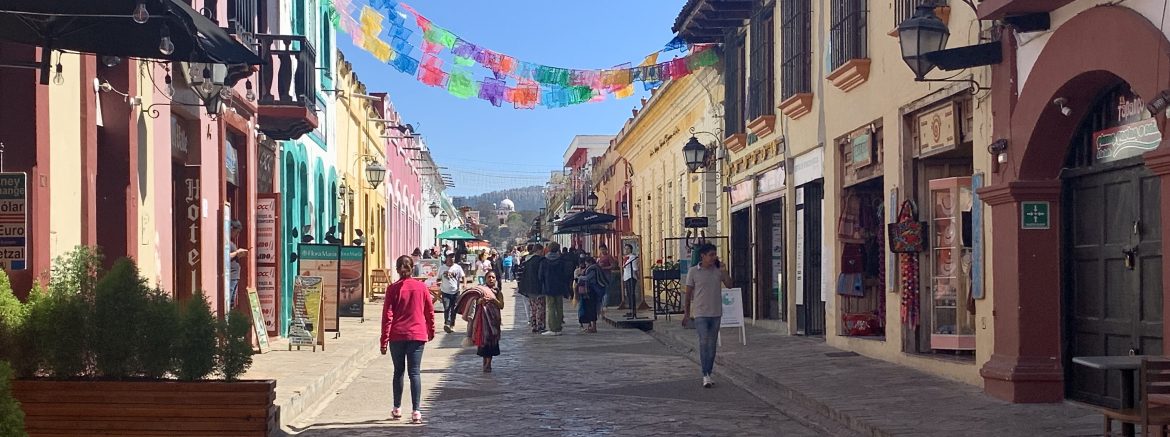
From Puerto Escondido, we took an overnight bus into the mountains to reach San Cristóbal de las Casas, one of Mexico’s most attractive colonial towns. At 2,200 metres above sea level, its cobbled streets, brightly painted low-rise buildings, and cool climate make it a perfect place for rest and reflection.
The indigenous Maya community, primarily Tzotzil and Tzeltal speakers, form a strong presence in San Cristóbal. Around the Templo de Santo Domingo de Guzmán, the daily market is packed with local crafts: handwoven textiles, carved wooden toys, pom-poms, and amber jewellery. Most stallholders make the products themselves, often weaving or beading between sales.
Chiapas is one of Mexico’s richest regions for indigenous textiles, particularly among the Tzotzil and Tzeltal Maya communities. The woven designs often include diamonds, zigzags, and stars, each carrying symbolic meaning. Some motifs represent maize fields, the cosmos, or spiritual guides. The tradition is not just aesthetic — textiles are a form of identity, tied to village, status, and ritual.
In San Cristóbal de las Casas, the Museo de Textiles del Mundo Maya (Museum of Maya Textile Culture) showcases exceptional examples of ceremonial dress, huipiles, and backstrap loom weaving, a craft still widely practised today by women in local villages.
Cultural Note – Weaving & Indigenous Continuity
There’s a strong sense of cultural overlap between Maya communities in Chiapas and Guatemala, especially in textile design. The use of backstrap looms, hand-dyed thread, and symbolic motifs feels strikingly similar to weaving traditions in Lake Atitlán and Chichicastenango. It’s a reminder that modern national borders don’t reflect cultural boundaries— this part of Chiapas feels more connected to highland Guatemala than to central Mexico.
The pedestrianised centre and main cathedral play host to a nightly artisan market and a lively food scene, especially busy on weekends when domestic tourists from Mexico City and beyond arrive in droves. Despite the visitor numbers, the feel remains local and relaxed.
Don’t miss the Mirador de San Cristóbal, accessible via a steep staircase from the lower town. At the top sits the Iglesia de San Cristóbal, a small hilltop church offering panoramic views over the tiled rooftops of the town and the surrounding green hills. It’s especially atmospheric at sunrise or late afternoon when the light softens and the town comes to life below.


San Cristóbal de las Casas: Catedral; Market; Chiapas Amber
One of the more unusual finds is Chiapas amber, fossilised tree resin found in the surrounding hills. Unlike the yellow Baltic amber familiar in Europe, Chiapas amber has a golden-orange hue and often contains insects and plant material dating back 25 million years. It’s found in the Simojovel region of Chiapas and is considered one of the most fossil-rich ambers in the world.
The Amber Museum in San Cristóbal (housed in the former Ex-Convento de la Merced) contains some astonishing specimens — including one with a perfectly preserved scorpion and another with a tiny lizard encased in time. It’s also a great place to verify authenticity, as fakes are common on the open market.
One unexpected trend in the night markets of San Cristóbal is the popularity of glow-in-the-dark T-shirts, often featuring psychedelic or shamanic designs, sometimes linked to Zapatista or indigenous symbolism. It’s unclear whether this is unique to San Cristóbal or simply a broader trend in tourist-heavy artisan towns, but the sheer volume and visibility of these shirts makes them a distinctive part of the town’s aesthetic.
Where we stayed: Hotel Posada El Zaguán, a family-run colonial hotel, with mountain views, internal courtyards, just a few blocks from the central square.
Restaurant Highlight: Restaurante Belil – A locally renowned restaurant just a few minutes’ walk from the centre, Belil specialises in regional dishes from Chiapas and San Cristóbal itself. The menu draws heavily on indigenous ingredients and preparation styles, showcasing traditional Chiapanecan cuisine in an elegant, contemporary setting and stylish presentation too.


Hotel Posada El Zaguán; Mirador de San Cristóbal; Templo de Santo Domingo de Guzmán; Restaurante Belil, Backstrap Loom; San Cristóbal de las Casas
San Cristóbal is a hub for Chiapan coffee, one of Mexico’s most respected growing regions – a shade grown arabica coffee. The cool climate and volcanic soil create ideal growing conditions, and many plantations are organic or Fair Trade certified.
Dotted around the colonial centre are numerous artisanal cafés, often sourcing directly from indigenous cooperatives in the surrounding highlands. These cafés not only serve high-quality espresso and pour-over brews but also act as cultural spaces, many host exhibitions, music, or book exchanges, and some even provide info about the coffee-growing process. Many also sell their specialist beans too. Look out for beans from high altitude San Juan Chamula, which has a chocolatey caramel flavour or lower altitude Comitán regions, which is more balanced.
Palenque: Mayan Temples in the Jungle
Reaching Palenque involved another long overnight bus, a loop back via Tuxtla Gutiérrez and into Tabasco Province before finally arriving at dawn. Palenque town itself is functional, but the magic lies in its proximity to the Palenque Archaeological Zone, surrounded by jungle and teeming with wildlife.
We based ourselves closer to the ruins and visited early. Entry requires two fees: a local state charge (cash only) and a federal INAH fee (card accepted). Sundays are free for Mexican nationals, so the site was busy but not overwhelming.


Temple of the Inscriptions; Howler Monkey; Royal Palace; Cross Group; Tomb of Pakal the Great; Mask in the Museum; Ball Court in Palenque
The layout is both dramatic and compact. The most iconic structure at Palenque is the Temple of the Inscriptions, built as the tomb of ruler Pakal the Great, towers over the main plaza, opposite the royal palace with its distinctive tower. It is a steep pyramid flanked by hieroglyphic panels, it houses a monumental limestone sarcophagus containing Pakal’s body, one of the few such royal tombs found in situ.
The carving on the sarcophagus lid has become famous for its enigmatic symbolism, with some claiming it depicts a spaceship (a theory now widely debunked). In reality, it shows Pakal falling into the underworld, framed by cosmological iconography. It’s one of the crowning achievements of Maya art and architecture.
Across a stream lies the Cross Group, a set of temples that can be climbed for elevated views and feature some of the finest carvings in the Mayan world.
Nearby are smaller pyramids, including the Temple of the Count, and a ballcourt. While much of the site remains hidden beneath vegetation, what is exposed demonstrates Palenque’s significance during the Classic and Late Classic periods (c. 600–800 AD), before it too succumbed to the regional collapse that ended the Mayan golden age.
The on-site museum, Museo de Sito de Palenque, Alberto Ruz Lhuiller, is excellent, highlights include jade funeral masks and the story of the Red Queen, whose remains were found intact in one of the tombs. The Red Queen was a noblewoman entombed in a richly adorned sarcophagus, found in Temple XIII in 1994. Her body was covered in bright red cinnabar; a pigment associated with royalty and rebirth.
Though her exact identity remains debated, many believe she was Lady Tz’akbu Ajaw, wife of the powerful ruler K’inich Janaab’ Pakal. Her tomb, remarkably well-preserved, offers rare insight into Mayan funerary rituals and elite status.
Palenque’s lush, jungle setting means it’s not just an archaeological wonder, it’s also teeming with wildlife, both seen and heard. Most notably, the area is home to howler monkeys, whose deep guttural roars echo through the trees at dawn and dusk, often mistaken for jaguars or large predators. Their sound can carry for several kilometres and creates an atmospheric backdrop to any visit. You’ll often spot howler monkeys swinging through the canopy within the archaeological park.
In quieter areas of the site, spider monkeys also make appearances, moving more fluidly and silently. Birdlife is rich too: look out for toucans, motmots, oropendolas, and parrots, especially early in the day. The region’s biodiversity is one of the reasons Palenque feels so immersive, it’s a site where nature and ancient civilisation overlap.
Where we stayed: Hotel Villa Mercedes Palenque, set in tranquil gardens just outside town, complete with its own troop of howler monkeys. Its design makes use of its jungle location with a series of thatched roofs bungalows surrounded by nature just outside town, and convenient for quick access to the Archaeological Site.
Palenque town, while slightly nondescript, is not just a gateway to ruins, it’s also a key waypoint for Haitian migrants either coming to Mexico to work or travelling further north to the U.S.–Mexico border. A processing centre operates here, and it’s not uncommon to see groups of Haitian families around town awaiting documents or onward travel. This gives Palenque a more international, transitory feel than many other small towns in the region, a reminder of modern migration flows running parallel to ancient trade routes.


Temple of the Inscriptions, Palenque; Paneque Museum; Agua Azul and Misol-Ha
Agua Azul and Misol-Ha: Waterfall Day Trips
A popular day trip from Palenque includes a stop at the Agua Azul waterfalls, a series of blue-tinted cataracts over limestone ledges, perfect for walking upstream and cooling off. Also nearby is Misol-Ha, a single tall waterfall you can walk behind for an immersive jungle experience. While touristy in parts, the natural beauty is undeniable. Some travellers also stop off here on route to San Cristóbal de las Casas.
We carried on our journey to Campeche in the Yucatan
Dates Visited: 1st to 7th February 2023