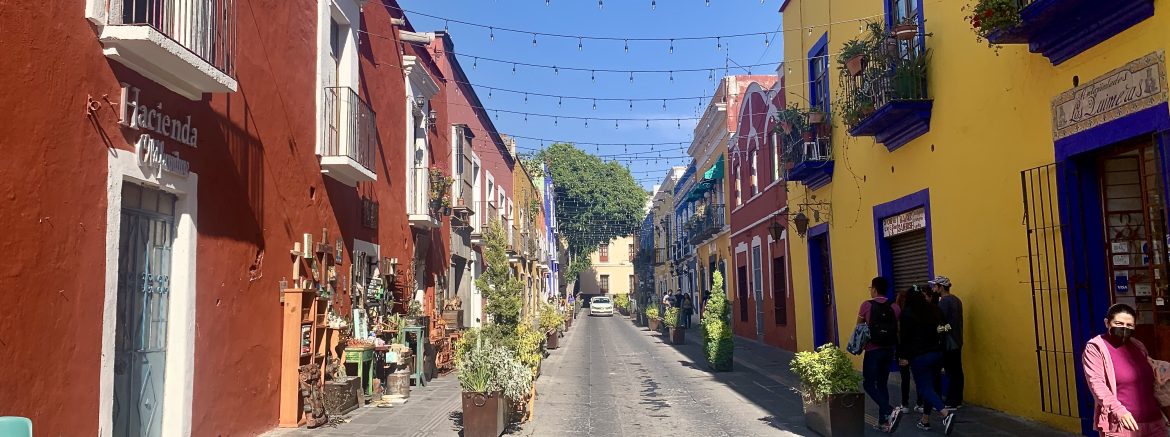
Mexico’s central highlands are filled with cities that gleam, some with the weight of colonial history, others with the unexpected joys of discovery. Puebla is rightly celebrated: for its cathedrals, cuisine and ceramics. But nearby Orizaba, tucked in the folds of Veracruz State, offers a different kind of charm — more subtle, more surprising, and arguably even more rewarding for the independently minded traveller. Together, they form a perfect loop out of Mexico City, with volcanoes in the background and colour on every street.
Table of Contents
Puebla: Cathedral City Full of Colour, Flavour, and Layers
Puebla de Zaragoza, the region’s historic capital, is a grand colonial city with a calm elegance,wide boulevards, tiled houses, monumental churches, and a deep sense of civic pride. It’s a place where the clash of empires and the richness of local tradition have created something distinctively Mexican.
The Catedral Basílica de Puebla, one of the largest in Latin America, dominates the skyline, its twin towers taller even than Mexico City’s. But it’s the Templo de Santo Domingo that steals the show inside: its Capilla del Rosario is almost impossibly ornate, with intricate Baroque stucco and radiant gold leaf shining from every surface. If you’re following a trail of Franciscan wealth across the country, this is a hard act to beat.
Puebla also claims to be the true birthplace of mole poblano, the rich chocolate-chilli sauce that is now famous around the world. The rivalry with Oaxaca runs deep, and while the latter may boast more variations, Puebla’s classic version is hard to top. We tried Comal, a refined spot offering traditional Poblano fare and mole in particular, and also La Porfiriana, an atmospheric restaurant right on the Zócalo, perfect for people-watching while sampling local classics.
We stayed at Collection O Al Otro Lado del Río, a beautiful hotel set in an old colonial building just a short walk from the centre. Its inner courtyards, with fountains, flowers, and vibrant poinsettias, made it feel like a private oasis in the heart of the city.
And it’s not just the food that’s worth savouring. Stroll toward the Plazuela de los Sapos, perhaps Puebla’s most atmospheric street, lined with antiques, ceramics, live musicians, and pastel-painted façades. This area lights up on weekends and is a wonderful place to watch the rhythm of local life unfold. The charming Callejón de los Sapos (“Alley of the Toads”) gets its name from the days when flooding drew croaking toads to the area. The nickname has stuck.
A little way from the main zócolo through a number of shopping streets, is the Mercado de Sabores Poblanos, is a more budget friendly option to Puebla’s food scene, with a large number of food stalls catering for all tastes. It is also where the buses to Cholula depart from.
Talavera Potter, Puebla’s Signature Craft
Puebla is also home to Talavera, a form of majolica-style pottery with roots in Spain but transformed here into something unique. Its white-glazed surfaces and cobalt blue patterns appear on everything from kitchen tiles to large urns, often mixed with yellow, green, or black. Genuine Talavera must be made in Puebla or nearby Atlixco, and many local workshops still follow traditional techniques. It’s one of the most recognisable — and exportable — forms of Mexican artisanal heritage.


Plazuela de los Sapos: Puebla Mole; Collection O Al Otro Lado del Río; Catedral Basílica de Puebla; Street Art; Templo de Santo Domingo and Capilla del Rosario
Cholula: Pyramid, Volcano and a Shadow of Betrayal
A short ride from Puebla, Cholula is a city that wears its layers openly — a Catholic church perched on top of a buried pre-Hispanic pyramid, with the snow-capped Popocatépetl volcano on the horizon. The Templo de Nuestra Señora de los Remedios, built by the Spanish in the 1590s, was a bold statement of conquest. Beneath it lies the Great Pyramid of Cholula — the largest pyramid (by volume) in the world, still partially unexcavated. Today, you can walk through its tunnels or climb to the church for expansive views of the surrounding valley.
Cholula also invites reflection on the darker side of conquest. The city was the site of one of Hernán Cortés’ most infamous massacres, when Spanish forces and their allies killed thousands of unarmed Cholulan nobles, allegedly to send a warning to others. It’s a moment still felt in the cultural memory of the region, and one that offers a useful counterpoint to the more glorified tales of colonial heroism.
Hernán Cortés and the Betrayal at Cholula
In 1519, during the early days of the Spanish invasion, Cortés invited Cholula’s leaders to a meeting, and then turned on them. With the help of Indigenous allies, he orchestrated a massacre that left thousands of dead. The motivations remain debated (was it a pre-emptive strike or pure intimidation?), but the legacy is clear: Cholula became a symbol of betrayal and domination, a turning point in the Spanish push toward the Aztec capital.
The town today has a gentler feel, full of students, rooftop bars, artisan markets and even a quirky museum dedicated to Mexican witchcraft. But the history here runs deep, and the combination of ancient, colonial and modern makes Cholula well worth at least a day trip.


Cholula Town View; Pyramid of Cholula; Templo de Nuestra Señora de los Remedios; Cholula Museum
Orizaba: A Mountain Retreat with Deeper Currents
From Puebla we headed into the hills, arriving in Orizaba, a quieter town with a cool mountain climate, lush surroundings, and a surprising mix of elegance and modern struggle. The town sits in the shadow of Pico de Orizaba, Mexico’s highest peak and the third-highest in North America. Though the summit is rarely visible from town, the mountain’s presence shapes everything — from climate and coffee cultivation to the sense of place.
Pico de Orizaba: The Sleeping Giant
Known as Citlaltépetl in Nahuatl, this stratovolcano rises to 5,636 metres, is Mexico’s tallest mountain. It straddles the border between Puebla and Veracruz States and is still considered potentially active. Its glaciated summit is a rarity this far south, and it’s a popular challenge for high-altitude climbers and not to be attempted without a guide / professional help and proper acclimatisation. The surrounding foothills grow some of the country’s best highland coffee, a vital link between landscape, economy, and daily ritual.
One of the best ways to understand Orizaba’s setting is to take the teleférico, (cable car) up Cerro del Borrego, a steep, forested hill that looms over the town. The ride itself is dramatic, one of the longest in Mexico, and at the summit you’ll find not only sweeping views across the valley and towards Pico de Orizaba on clear days, but also a small museum recalling the Battle of Cerro del Borrego in 1862, part of Mexico’s resistance to French intervention. It’s a powerful spot — mixing nature, history, and geography in a way that makes the town’s past and present feel fully connected.
Down below, the riverwalk, surprisingly long and thoughtfully landscaped, shows a different side of the town: both a haven for families and a small case study in social reintegration. We started mid-way along Orizaba’s unexpectedly long riverwalk, when a small street sign pointing toward “jaguares” caught our eye. What we discovered was something far more surreal: several jaguars, including a rare black one, along with three spectacled bears, lions, tigers (including a nearly white one), hippos, monkeys, and macaws — all housed in spacious paddocks running for kilometres along the riverbank.
These animals were rescued from illegal captivity; many having been confiscated from cartel members and others in Mexican society who illegally kept them as exotic pets or trophies. Their long exposure to captivity makes it impossible for them to return to the wild — a stark reminder of the complicated, bizarre and brutal intersections of wealth, power, and nature in modern Mexico.
The riverwalk also acts as a canvas for social reintegration. Some of the landscaping and maintenance is carried out by people emerging from addiction or incarceration, supported by municipal programmes. It’s a moving combination of public beauty and private rehabilitation, playing out in the heart of a town that rewards those who take time to explore.


Riverwalk Orizaba
We stayed at the Gamma Orizaba Grand Hotel de France, a well-located colonial-era hotel with upper-floor balconies draped in peace lilies, offering calm and quiet in the centre of town. Our favourite restaurant was Marrón Cocina Galería, where we ate twice, it’s consistently ranked near the top of local reviews, and with good reason. Set in a grand casona (old colonial house), it also houses a gallery of regional arts and handicrafts, making the experience as much cultural as culinary. The menu blends Italian / Mexican fusion, with dishes that feel both inventive and rooted.
At the centre of town, Orizaba also boasts one of the most unusual city halls in Mexico: the Palacio de Hierro, a wrought-iron building designed by Gustave Eiffel and shipped over from France in 1892. While it once served purely administrative functions, it now houses several small museums, including one dedicated to Mexican beer, and the ground floor is lined with cafes and restaurants that open onto the plaza, a subtle blend of Old-World elegance and Mexican sociability.
Housed in a striking historic complex is the Poliforum Mier y Pesado, a small but worthwhile museum focuses on textile traditions from across Mexico, with beautifully preserved examples of indigenous dress and ceremonial costume. It’s a reminder of the deep continuity between the past and present, and of how regional identity is woven, quite literally, into the fabric of daily life.
Despite all this, Orizaba remains far off the mainstream tourist trail, especially compared to Puebla or Oaxaca. And yet, for those willing to wander, it offers one of the most surprising and quietly compelling small-city experiences in Mexico, a place where local pride, unusual stories, and beautiful mountain light all come together.


Palacio de Hierro; Catedral de Orizaba; View from Cerro del Borrego; Textiles at Poliforum Mier y Pesado
From Orizaba our next destination was Oaxaca where we travelled by ADO bus.
Dates Visited 17th to 23rd January 2023